


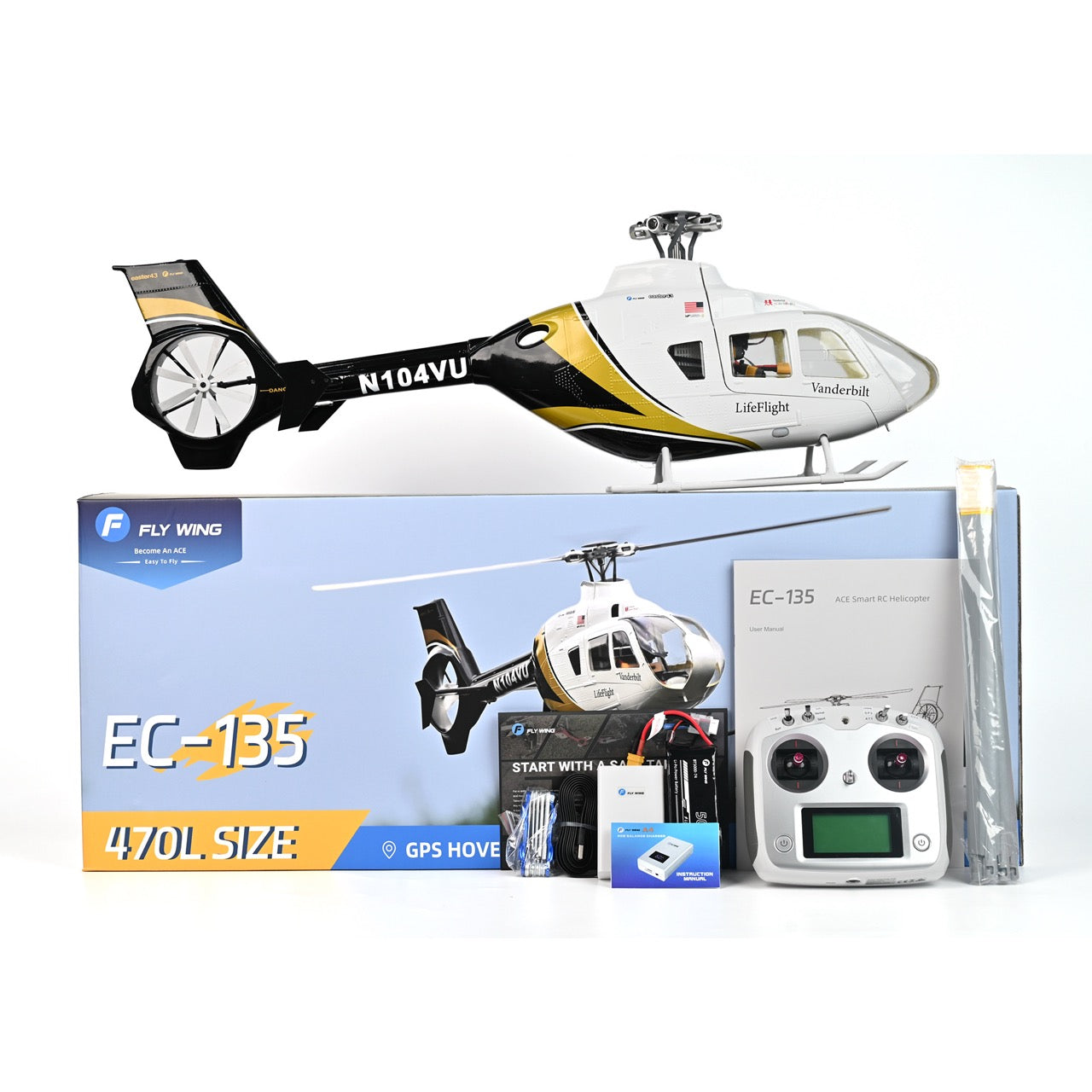
Product details
How it flies
In plain words
-
Let go and it holds
In GPS mode, let go of the sticks and the ACE flight controller holds the helicopter in place, so you always have time to think.
-
One switch brings it home
Flip the return switch and it flies back and lands where it took off. It also heads home on its own when the battery runs low.
-
It checks the battery first
If the battery is not fully charged, the lights flash red and yellow and it will not take off.

GPS or ATT: choose how much help you get
Start in GPS mode, where the ACE flight controller holds position for you. Switch to ATT mode when you want more hands-on flying: the helicopter stays level but no longer holds its spot, so it flows more like a scale aircraft.

The signature Fenestron tail
Like the real EC135, the tail rotor sits inside a ducted Fenestron shroud, the feature that makes the full-size aircraft quieter and safer around people on the ground. It gives the model its unmistakable silhouette.

Compass calibration from the transmitter
No computer is needed in the field. Toggle the mode switch three times to start calibration, rotate the helicopter while the LED turns from red to yellow to green, and it restarts by itself when it is done.

LifeFlight air medical colours
The EC-135 LF wears a Vanderbilt LifeFlight air medical scheme in white, gold and black, with N104VU registration markings, a clear cockpit and scale skids.

Four-blade rotor head
A four-blade rotor head gives the EC-135 LF the busy, purposeful look of the real aircraft, both on the ground and turning in the air.

Learn with the official tutorial
The EC135 flight tutorial for the ACE flight controller, in the Media tab, walks you through setup and your first flights, and our Tutorials page covers binding and compass calibration.


The real aircraft
The story of the EC135
The EC135 is a twin-engine light helicopter from Airbus Helicopters, formerly Eurocopter, developed from Germany's MBB BO 108. Its ducted Fenestron tail rotor keeps noise low and safety high, and it flies medical, police, tourism, business and military training missions.
-
1980s
MBB flies the BO 108, the experimental helicopter that leads to the EC135.
-
1996
The Eurocopter EC135 is certified and enters service.
-
Today
Our EC-135 LF recreates it in a Vanderbilt LifeFlight air medical scheme.
Up close
Built to look like the real thing
-

Cockpit and LifeFlight markings -

Four-blade rotor head -

Nose and livery stripe -

Light under the tail boom


Videos
Watch it fly
-
EC135 Flight Tutorial | ACE Flight controller
-
Things to Be Aware of During Your First Flight
-
Rotor Blade Installation Tutorial
| Model | FLYWING EC-135 LF 470 ACE GPS/ATT |
|---|---|
| Type | Scale RC helicopter, ready to fly (RTF) |
| Flight controller | FLYWING ACE GPS/ATT |
| Positioning | GPS |
| Flight modes | GPS and ATT |
| Safety | One-key return, low-battery return, battery check before takeoff |
| Main rotor head | Four-blade |
| Battery | 4S LiPo, 5000 mAh |
| Transmitter | FLYSKY FS-i6S, 10-channel 2.4 GHz |
| Class | 470 |
| Tail | Scale ducted Fenestron |
| Compass calibration | From the transmitter |
| Scheme | Vanderbilt LifeFlight air medical |
| Item | Qty |
|---|---|
| FLYWING EC-135 LF helicopter | 1 |
| Main rotor blades | 1 set |
| FLYSKY FS-i6S 10-channel transmitter | 1 |
| 4S 5000 mAh LiPo flight battery | 1 |
| Balance charger with power cord | 1 |
| USB-A to USB-C data cable | 1 |
| Binding cable | 1 |
| Multi-purpose hex screwdriver | 1 |
| User manual | 1 |
Is the EC-135 LF a good first RC helicopter?
It can be, in GPS mode. The ACE flight controller holds the helicopter in place when you let go of the sticks, and one switch brings it home, so a new pilot can learn step by step. Start in a large open field and practise hovering first.
What do I need before the first flight?
Four AA batteries for the transmitter, a fully charged flight battery and a large open space away from people, trees and buildings. In the US, recreational pilots must pass the FAA TRUST test, and models over 250 g (0.55 lb) must be registered with the FAA.
How do I take off for the first time?
Switch on the transmitter, select GPS mode and connect the battery. Wait until the GPS has locked before you start the motors, then lift off gently to a safe hover height.
What happens if I lose orientation or the battery runs low?
Flip the return switch and the helicopter flies back and lands where it took off. It also starts the return by itself when the battery reaches its safety level. Fly where the path home is clear of trees and buildings.
I fly fixed-wing. How different is flying a helicopter?
A helicopter can hover and move in any direction, and the left stick controls height rather than airspeed. In GPS mode, centring the sticks holds the helicopter in place instead of letting it glide on, which takes a little getting used to.
How hard is the switch from fixed-wing to helicopter?
GPS mode removes the hardest part, holding a hover, so you can learn orientation and stick feel first. When that feels natural, move on to forward flight and gentle circuits.
Can I fly it without GPS assistance?
Yes. ATT mode keeps the helicopter level but does not hold its position, so it drifts with the wind and you fly it more directly. Switch modes only at a safe height.
Why won't it take off?
The flight controller checks the battery before takeoff. If the battery is not fully charged, the LED flashes red and yellow and the motors will not start. Fit a fully charged battery and try again.
How do I calibrate the compass?
No computer is needed. Toggle the mode switch three times to enter calibration, then rotate the helicopter while the LED changes from red to yellow and finally green. The system restarts by itself when calibration is complete.
What is a Fenestron?
It is the ducted tail rotor used on the real EC135: the rotor spins inside a shroud in the tail fin, which makes the full-size helicopter quieter and safer. The model recreates the shroud for a true-to-life look.
Where can I learn to fly it?
Watch the EC135 flight tutorial for the ACE flight controller in the Media tab and read the user manual before your first flight. Our Tutorials page has more guides on binding and compass calibration.
