


Product details
How it flies
In plain words
-
Let go and it holds
In GPS mode, M10 positioning with GPS, GLONASS and Galileo keeps the helicopter steady in one place, so you always have time to think.
-
One switch brings it home
Flip the return switch and it flies back to where it took off. It also heads home on its own when the battery runs low.
-
Lost signal? It comes back
If the radio link drops, the helicopter starts its return by itself instead of drifting away.

Satellite positioning you can rely on
The M10 module tracks GPS, GLONASS and Galileo satellites, so the helicopter holds its spot to within about 1.5 m horizontally and 0.5 m vertically when the signal is good. Semi-automatic assisted flight keeps the controls calm while you learn.

Direct-drive brushless tail
There is no tail shaft or belt to adjust. A brushless motor in the tail drives the tail rotor directly, which is efficient, responsive and has fewer parts to maintain, and the aerodynamic tail design adds stability.

3508 brushless power, up to 20 minutes
A 3508 brushless main motor with a 13T motor gear and 81T main gear, run by a 60A ESC, gives up to 20 minutes per battery, well beyond the 5 to 10 minutes of many RC helicopters.

80 cm rotor for steady flight
The large rotor of about 80 cm gives the AS350 a calm, stable feel in the air, and digital servos keep the controls precise. The blades fit on in minutes when the helicopter arrives.

Swiss mountain rescue colours
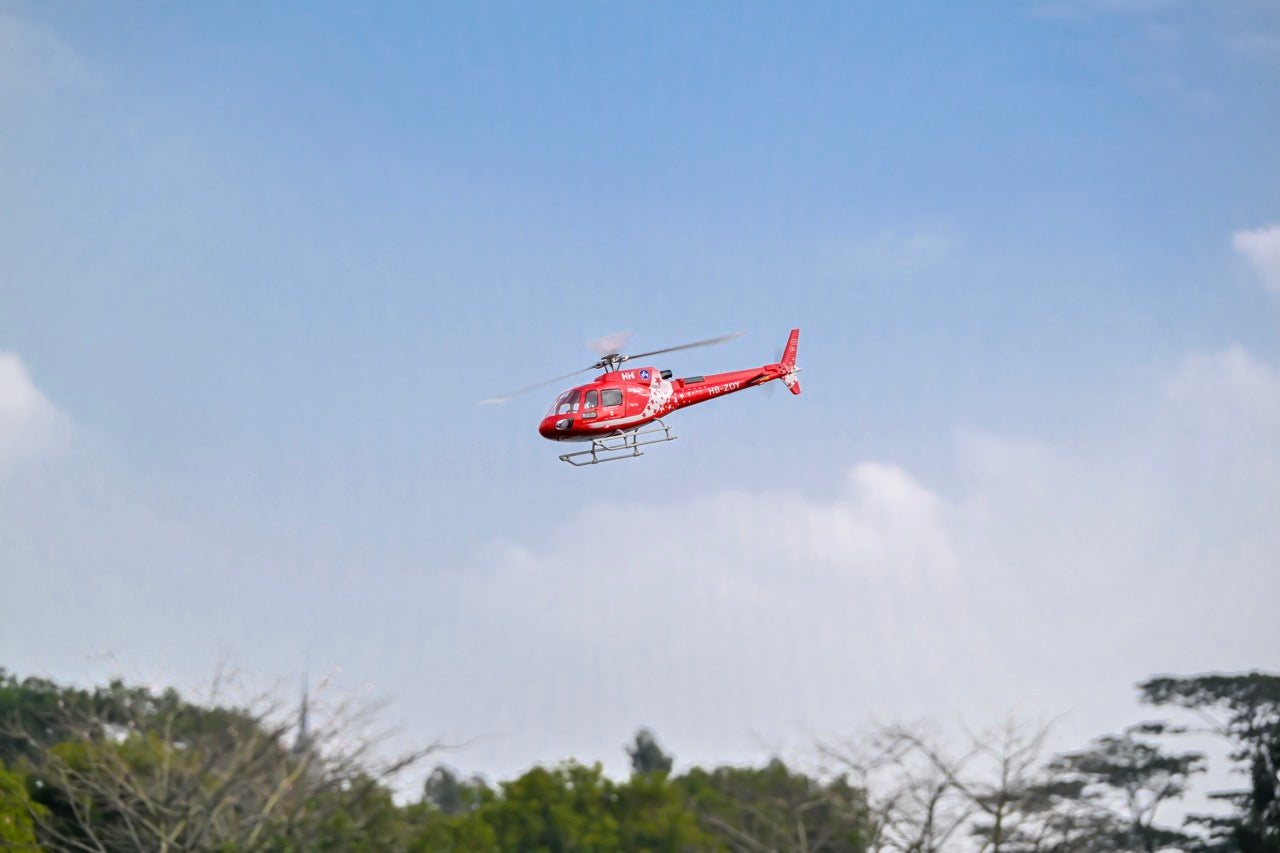
The AS350 wears Air Zermatt's red and white scheme with star graphics, clear cockpit glazing and refined scale structure, capturing the excellent all-round visibility the real aircraft is known for.

Quick battery access
The canopy lifts off by hand for direct access to the battery and electronics, so swapping batteries between flights takes moments.


The real aircraft
The story of the AS350
The AS350 is a light, single-engine utility helicopter originally developed by Aérospatiale, now part of Airbus Helicopters. Known for excellent visibility, reliable performance and strong high-altitude capability, it flies aerial work, sightseeing, police, rescue and private missions around the world.
-
1970s
Aérospatiale flies the first AS350 Écureuil, known in North America as the AStar.
-
2010s
Airbus Helicopters renames it the H125, still prized for its high-altitude performance.
-
Today
Our AS350 recreates it in Air Zermatt's red and white mountain rescue colours.
Up close
Built to look like the real thing
-

Cockpit and Air Zermatt markings -

Rotor head -

Tail boom and stabiliser -

Battery and electronics bay


Videos
Watch it fly
-
Things to Be Aware of During Your First Flight
-
Rotor Blade Installation Tutorial
| Model | FLYWING AS350 ACE GPS/ATT |
|---|---|
| Type | Scale RC helicopter, ready to fly (RTF) |
| Flight controller | FLYWING ACE GPS/ATT |
| Positioning | M10 module with GPS, GLONASS and Galileo |
| Flight modes | GPS and ATT; semi-automatic assisted flight |
| Safety | One-key return, lost-signal return, low-voltage return |
| Main rotor diameter | About 80 cm (31.5 in) |
| Main motor | 3508 brushless |
| Tail motor | Brushless, direct drive |
| ESC | 60A |
| Servos | Digital |
| Battery | 4S LiPo, 5000 mAh |
| Flight time | Up to 20 minutes |
| Transmitter | FLYSKY FS-i6S, 10-channel 2.4 GHz |
| Gears | 13T motor gear, 81T main gear |
| Hover accuracy | About ±1.5 m horizontal, ±0.5 m vertical with a good GPS signal |
| Recommended age | 14+ |
| Item | Qty |
|---|---|
| FLYWING AS350 helicopter | 1 |
| Main rotor blades | 1 set |
| FLYSKY FS-i6S 10-channel transmitter | 1 |
| 4S 5000 mAh LiPo flight battery | 1 |
| Balance charger with power cord | 1 |
| USB-A to USB-C data cable | 1 |
| Binding cable | 1 |
| Multi-purpose hex screwdriver | 1 |
| User manual | 1 |
Is the AS350 a good first RC helicopter?
It can be, with supervision. GPS mode holds the helicopter in place and assisted flight keeps the controls calm, so a new pilot can learn step by step. FLYWING recommends it for ages 14 and up; start in a large open field and practise hovering first.
What do I need before the first flight?
Four AA batteries for the transmitter, a charged flight battery and a large open space away from people, trees and buildings. The rotor blades ship separately in the box, so fit them first. In the US, recreational pilots must pass the FAA TRUST test, and models over 250 g (0.55 lb) must be registered with the FAA.
How long does it fly?
Up to 20 minutes per battery, compared with the 5 to 10 minutes of many RC helicopters. Wind, flying style and battery condition all affect it.
What happens if I lose the signal or the battery runs low?
It starts a return to its takeoff point by itself when the radio signal is lost or the battery voltage drops, and you can trigger the same return with one switch. Fly where the path home is clear of trees and buildings.
I fly fixed-wing. How different is flying a helicopter?
A helicopter can hover and move in any direction, and the left stick controls height rather than airspeed. In GPS mode, centring the sticks holds the helicopter in place instead of letting it glide on, which takes a little getting used to.
How hard is the switch from fixed-wing to helicopter?
GPS mode removes the hardest part, holding a hover, so you can learn orientation and stick feel first. When that feels natural, move on to forward flight and gentle circuits.
Can I fly it without GPS assistance?
Yes. ATT mode keeps the helicopter level but does not hold its position, so it drifts with the wind and you fly it more directly. Switch modes only at a safe height.
How precise is the GPS hover?
With a good signal, about 1.5 m horizontally and 0.5 m vertically. The M10 module uses GPS, GLONASS and Galileo satellites together for a steadier lock.
What does direct-drive tail mean?
Instead of a tail shaft or belt driven from the main gearbox, a brushless motor sits in the tail and drives the tail rotor directly. There is less to adjust and fewer parts to wear.
Does it arrive ready to fly?
Yes. It comes pre-assembled and adjusted; because of the packaging, you attach the rotor blades before the first flight.
What colours does it come in?
It is finished in Air Zermatt's red and white mountain rescue scheme, with HB-ZOY registration markings.
Where can I learn to fly it?
Watch the first-flight and blade installation videos in the Media tab and read the user manual before your first flight. Our Tutorials page has more guides on binding and compass calibration.
